
Developed trail
Events
When someone chooses to participate in a Proxima Event, we help them participate well, carry forward what was useful, and respond faithfully to what they explicitly ask of us.
Stage 1 of 7
Purpose
Why are we doing this?
Event Follow-up begins when someone registers or explicitly commits to participate. We help them participate well, follow up appropriately, and respond without inferring more than they expressed.
Stage 2 of 7
Message
What are we saying?
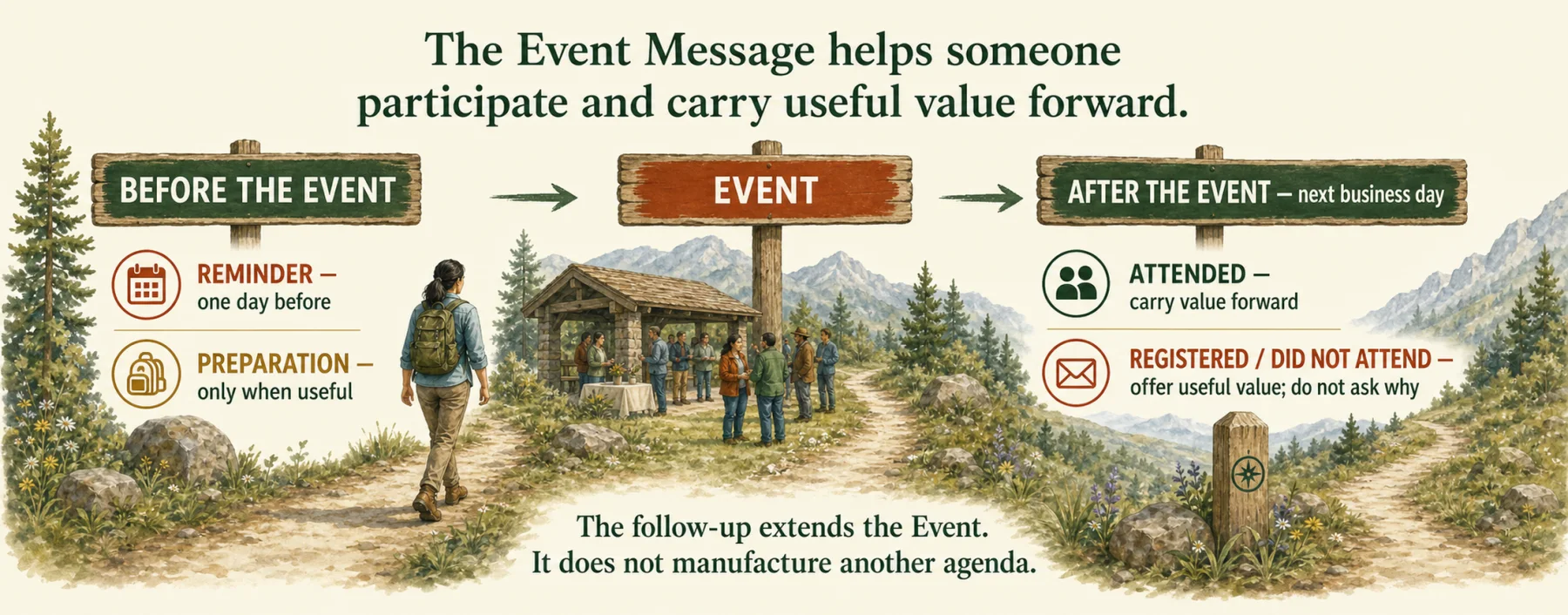
The Event Message helps someone participate and carry useful value forward.
| Moment | What the Message does |
|---|---|
| Before the Event | Send a practical reminder one day before. Add preparation only when it will genuinely help. |
| After attendance | The next business day, acknowledge participation and share the central takeaway, promised material, or useful resource. |
| After registration without attendance | The next business day, offer useful value without asking the person to explain why they did not attend. |
The follow-up extends the Event. It does not manufacture another agenda.
Do not automatically add unrelated fundraising, coaching, or volunteer invitations. Make an appropriate response easy without manufacturing one.
Stage 3 of 7
People
Who is this for, right now?
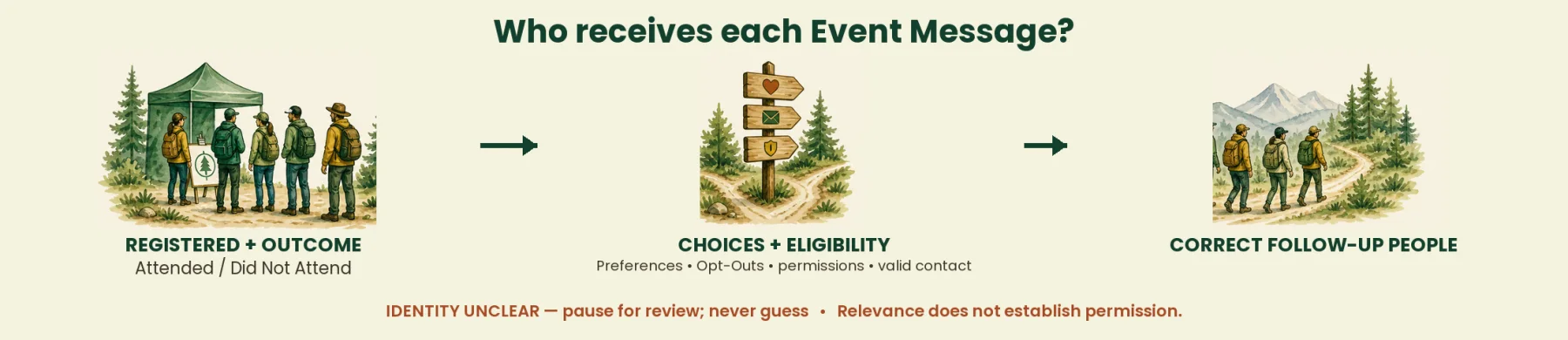
We distinguish the people who registered and attended, registered and did not attend, made a specific request, and are eligible for the applicable follow-up.
Relevance does not establish permission.
Communication Preferences, Opt-Outs, suppressions, Channel permissions, valid contact information, and delivery exclusions still govern who receives each Message. If identity is unclear, pause for review; never guess.
Stage 4 of 7
Delivery
How and where does it reach them?
The relationship pathway follows one clear sequence:
Registration → reminder one day before → optional preparation when useful → Event outcome → follow-up the next business day
Use the Attended or Registered / Did Not Attend Message variant. Include a recording or useful resource in that standard follow-up when appropriate; do not create a separate distribution journey.

Stage 5 of 7
Reaction
What did they do?
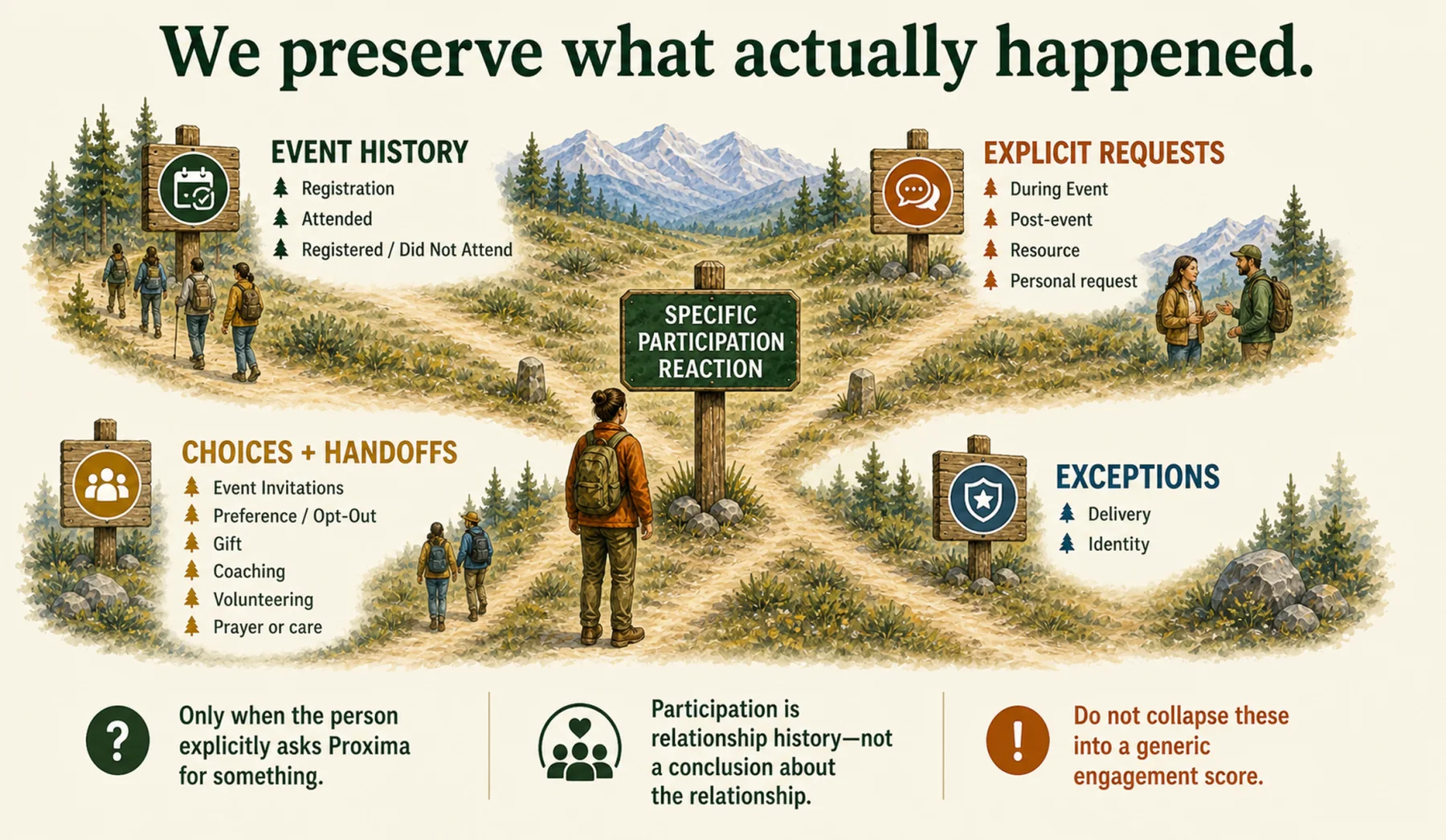
We preserve what actually happened:
registration • attended • registered / did not attend • specific request during the Event • explicit post-event request • Event Invitations request • preference change or Opt-Out • Gift • coaching • volunteering • prayer or care request • delivery or identity exception
A Specific Participation Reaction exists only when the person explicitly asks Proxima for something during the Event. General participation, chatting, or passive engagement does not create that Reaction.
Participation is relationship history—not a conclusion about the relationship.
Do not collapse these distinct signals into a generic engagement score.
Stage 6 of 7
Next Action
What do we do next?
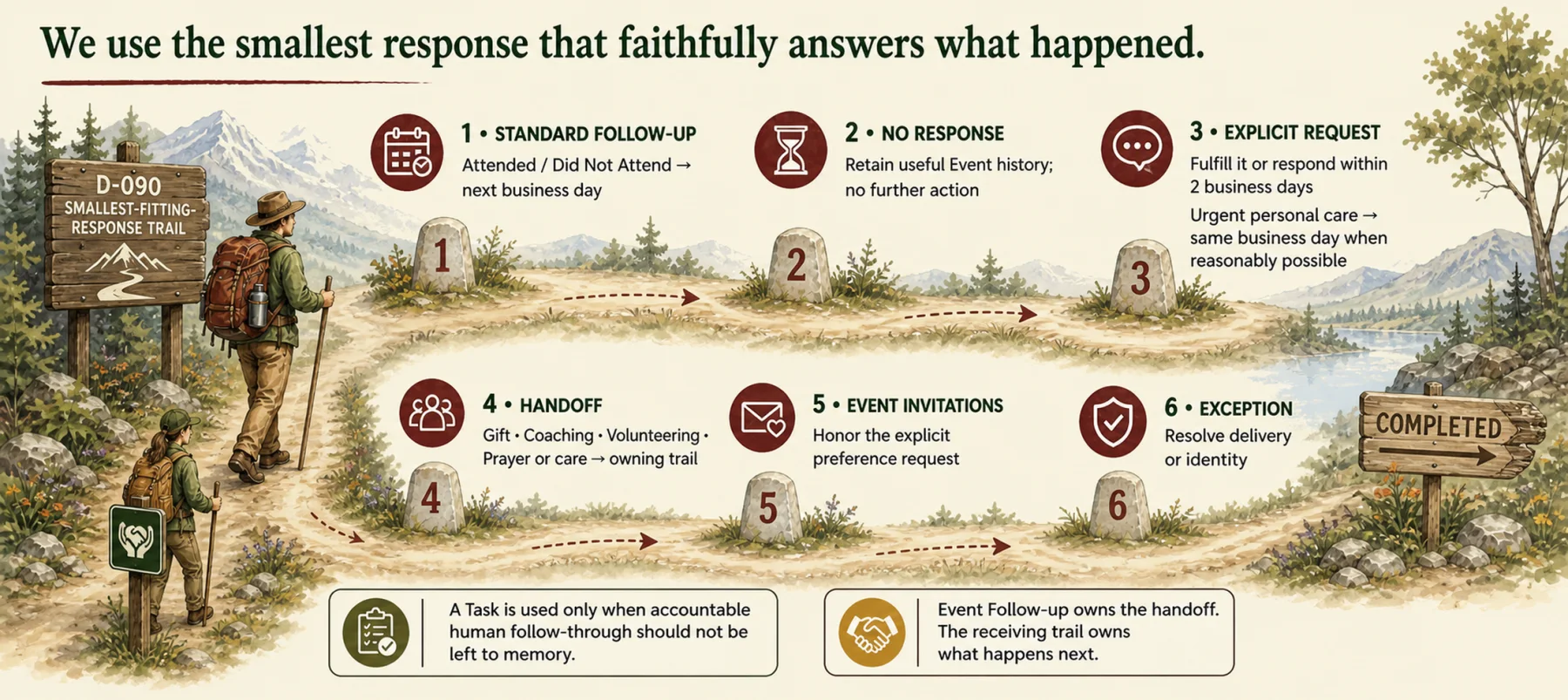
Use the smallest response that faithfully answers what happened.
| What happened | What happens next |
|---|---|
| Registration | Send the reminder; provide preparation when useful. |
| Attended or Registered / Did Not Attend | Send the appropriate follow-up the next business day. |
| No post-event response | No further action; retain useful Event history. |
| Resource request | Fulfill the specific request. |
| Personal request | The right founder responds within 2 business days. |
| Urgent personal-care request | Founder response the same business day when reasonably possible. |
| Gift • coaching • volunteering • prayer or care | Hand off to the owning trail and its approved timing. |
| Event Invitations request | Honor the explicit preference request. |
| Delivery or identity exception | Resolve through the applicable exception pathway. |
A Task is used only when accountable human follow-through should not be left to memory. Event Follow-up owns the handoff; the receiving trail owns what happens next.
Stage 7 of 7
Learn
What do we carry forward?
Within 5 business days after the post-event follow-up, we review:
who registered, attended, or did not attend • what people explicitly asked for • what follow-up or handoffs resulted • what seemed useful • what we should repeat, change, or stop next time
We learn from specific Event history and explicit choices—not a generic engagement score.
Relational Takeaway
Choosing to participate matters. We help people participate well, carry forward what was useful, and respond faithfully without assuming more than they expressed.