Proxima Partners circle mark
PROXIMA RESPONSIVE OPERATING SYSTEM

The PROS
Journey

A relational way to communicate, respond, and learn — told the way it actually works: as a journey, one stage at a time.
August 2026 · Revision 1.0
Approved PROS Journey pictorial
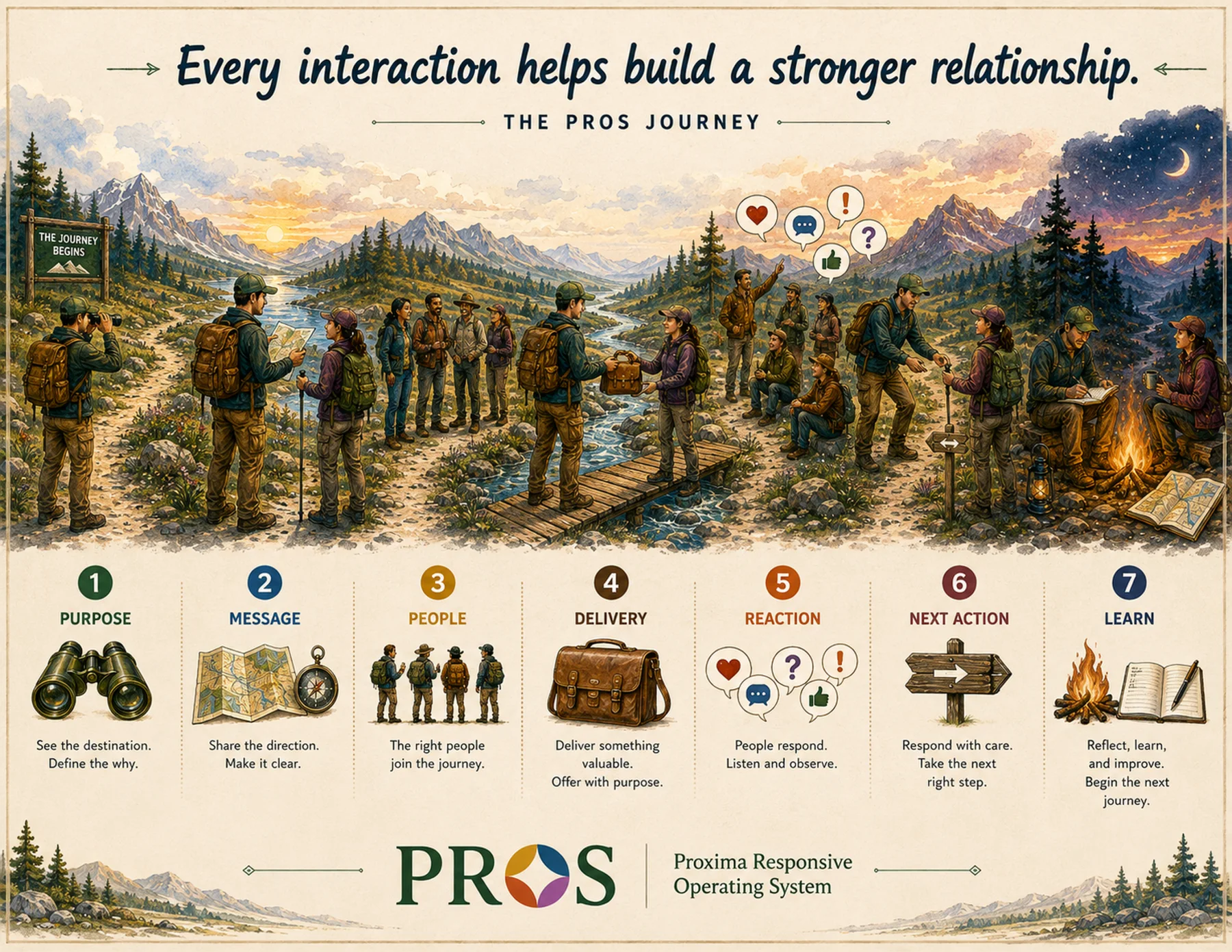
Hikers helping one another across a mountain stream
THE PROS JOURNEY

We Build Relationships.
Not Transactions.

Every leg of this journey — Purpose, Message, People, Delivery, Reaction, Next Action, Learn — exists to serve one commitment: the relationship comes first, every time.

Trail compass with return arrowRespond to Reactions rather than broadcasting indiscriminately.
Topographic map with a highlighted routeFavor dynamic Queries over static Lists.
Field journal beside a trail markerTreat preferences and opt-outs as meaningful signals.
Camping lantern illuminating a trail guideUse automation to support care, never to replace judgment.
“Every interaction helps build a stronger relationship.”
THE PROS JOURNEY

Why We Walk

“Build and strengthen relationships rather than treating people as transactions.”

Proxima built PROS — the Responsive Operating System — to help two founders make consistent, practical decisions about the people they walk alongside: what they're doing it for, what they're saying, who needs to hear it, how and when it reaches them, what happens next, and what to carry forward.

It isn't a comprehensive software manual. It's a living way of working, meant to stay proportionate to a small, relational organization — improved as it's used, not fixed in stone.

The chapters ahead follow a single path with seven stages: Purpose → Message → People → Delivery → Reaction → Next Action → Learn. The same seven stages, every time, whatever the work — a thank-you note, a newsletter, a prayer update, a first gift.

This is PROS, told PROS-forward. Where the work touches Virtuous — the system that carries it out — that connection is named plainly, without the technical detail getting in the way of the relationship.

Purpose
Message
People
Delivery
Reaction
Next Action
Learn
WAYPOINT 1 OF 7
Purpose
“Why are we doing this?”

A hiker stops at the trailhead and looks through binoculars toward the destination. Before anyone takes a step, the destination has to be worth walking toward.

Every leg of the PROS journey starts here. Purpose names the reason for the work — the relationship or outcome Proxima hopes to support — before a single word is written or a single name is chosen.

Purpose keeps activity from becoming an end in itself. If the reason for a communication can't be named plainly, it isn't ready to leave the trailhead.

How Proxima walks this stage

Thank a donor promptly · Invite someone into informed prayer

Purpose
Message
People
Delivery
Reaction
Next Action
Learn
WAYPOINT 2 OF 7
Message
“What are we saying?”

Two hikers unfold a trail map. They agree on the route before anyone moves — the map has to be right, or the walk goes nowhere useful.

Message is the specific idea, story, invitation, or response Proxima puts into words for a particular relationship purpose. It has to say the right thing, to the right person, for the right reason — not just something.

A clear Purpose makes the Message almost write itself: once you know why you're speaking, you mostly know what to say.

How Proxima walks this stage

A sincere, specific acknowledgment · A clear, honest ministry update

Purpose
Message
People
Delivery
Reaction
Next Action
Learn
WAYPOINT 3 OF 7
People
“Who is this for, right now?”

The hikers meet the travelers joining this leg of the journey. Not everyone walks every leg; the right people join the ones that are relevant to them.

People asks who is relevant to this Message, right now — based on the relationship, current activity, preferences, and plain good judgment. This is relevance, not yet delivery: PROS separates who belongs in the conversation from who ultimately receives it.

The next chapter, “Who Joins This Leg,” walks through exactly how PROS keeps that group current instead of frozen.

How Proxima walks this stage

A first-time donor who just gave · People with an active prayer relationship

Purpose
Message
People
Delivery
Reaction
Next Action
Learn
WAYPOINT 4 OF 7
Delivery
“How and when does it reach them?”

A satchel changes hands at a footbridge. Something is carried across, at the right moment, in the right way, to the right person.

Delivery chooses the method, timing, and care that fit both the Message and the relationship. A prompt thank-you and a quarterly update don't travel the same way, or at the same pace — Delivery is where that judgment gets applied.

Before anything actually goes out, PROS checks preferences, opt-outs, and any reason a person shouldn't receive this particular Message right now.

How Proxima walks this stage

An immediate email receipt · A scheduled letter, timed with care

Purpose
Message
People
Delivery
Reaction
Next Action
Learn
WAYPOINT 5 OF 7
Reaction
“What did they do?”

Travelers respond in their own ways — a question, a thumbs up, a quiet nod, no response at all. Every reaction is information, whether or not it's loud.

Reaction is simply what a person does, says, or causes after Delivery — a reply, a gift, a registration, a preference change, a delivery failure, or no engagement at all. Every one of these is a signal worth noticing.

Reaction belongs to the person on the trail, not to Proxima. Next Action, the following stage, is what Proxima chooses to do about it.

How Proxima walks this stage

A reply, a gift, a registration · A quiet preference change, or no reply at all

Purpose
Message
People
Delivery
Reaction
Next Action
Learn
WAYPOINT 6 OF 7
Next Action
“What do we do next?”

At a trail signpost, a hiker points the way. Someone noticed what happened and chose, deliberately, what should happen next.

Next Action is Proxima's response to a Reaction — chosen with judgment, not decided automatically. A Reaction informs the response; it never mechanically determines it.

Most Reactions call for a workflow, a quiet record update, or an intentional choice to do nothing yet. A few call for a person to own the follow-up personally — the next chapter explains exactly when that line gets crossed.

How Proxima walks this stage

A founder replies personally · A record updates itself, quietly, with no Task at all

Purpose
Message
People
Delivery
Reaction
Next Action
Learn
WAYPOINT 7 OF 7
Learn
“What do we carry forward?”

By the fire that evening, the hikers open a journal. They talk over what worked, what didn't, and what the next journey should carry forward.

Learn closes the loop. Proxima looks back at what happened — the Reactions, the outcomes, the near-misses — and decides what should change, what should be repeated, and what the next journey should carry forward.

Then the path begins again at Purpose, a little wiser than the last time it set out.

How Proxima walks this stage

What made this Message land well · What the next newsletter should do differently

Purpose
Message
People
Delivery
Reaction
Next Action
Learn
SECTION TWO

Tools We Use

PROS keeps the relationship judgment clear. Pete helps connect that thinking to the tools in Virtuous that prepare People and Delivery.

TOOLS WE USE

Three Roles, One Operating System

PROS defines the thinking. Virtuous supports the work. Pete helps us understand and apply it.
PROSDefines the thinking
VirtuousSupports the work
Proxima PetePeteLinks PROS language to Virtuous detail
PROS — relationship thinking

The seven-stage model, Playbooks, relational judgment, and learning remain platform-independent.

Pete — understanding and application

Retrieves relevant Proxima knowledge and translates between plain relational language and precise Virtuous detail. Founders still decide.

Virtuous — operating support

Holds Campaigns, Communications, Segments, delivery records, Reactions, Tasks, and reporting.

Proxima Partners circle mark

PROS

Defines the thinking. The seven-stage journey, the language, the judgment calls — PROS is how Proxima decides what a relationship needs, independent of any particular tool.

Pete

Helps us understand and apply it. Pete retrieves what Proxima already knows, translates between plain relational language and precise system detail, and helps connect PROS thinking to Virtuous configuration. Founders still make the calls that matter.

Virtuous

Supports the work. Virtuous is where campaigns are organized, communications are held, and gifts, replies, and preferences are recorded — the system of record that carries PROS thinking into action.

Founders retain judgment and decision authority. Nothing here changes without Mike's approval.
Approved PROS Journey pictorial
SECTION TWO

Tools We Use

PROS keeps the relationship judgment clear. Pete helps connect that thinking to the tools in Virtuous that prepare People and Delivery.

PROXIMA RESPONSIVE OPERATING SYSTEM

How PROS Defines People and Prepares Delivery

PROS defines People dynamically, then Virtuous prepares them for Delivery.
Purpose
Message
People
Delivery
Reaction
Next Action
Learn

People

Who should receive the Message?
Query Primary means

Identifies who is relevant now as relationship information changes.

Tag Durable context

Preserves selected enduring interests, roles, affiliations, or characteristics.

List Fixed exception

Preserves intentionally fixed membership when it must not update dynamically.

Delivery

How are the selected People applied?
Segment

Applies the selected People to a specific Campaign or Communication for delivery and reporting.

  • Exclusions and suppressions
  • Delivery preparation
  • Tracking and reporting
  • Comparison of Reactions

Query, Tag, or List flow into a Segment as needed — a Segment does not require all three.

PROS defines who is relevant now. Virtuous turns that decision into a Segment for Delivery.
THE PROS JOURNEY

Who Joins This Leg

Before every leg of the journey, PROS asks one question: who is relevant right now? Not everyone stays on the trail for every leg — and PROS has four tools for keeping that answer current.

QUERY · the primary means

A living, dynamic set of criteria — who meets these conditions right now. Membership updates automatically as relationships change. This is how PROS finds who's relevant today, not who was relevant last month.

TAG · durable context

A label for something that stays meaningfully true across many journeys — an interest, a role, an affiliation. Not for anything temporary or already knowable from current data.

LIST · a fixed exception

A deliberately frozen roster, kept exact on purpose — an event guest list, a board term. Used only when membership must not change on its own.

SEGMENT · ready for delivery

Where Query, Tag, or List come together for one specific Message — the actual group who receives it, after preferences and exclusions are applied.

Query · Tag · List  →  Segment  →  Delivery — a Segment never needs all three, and relevance is always decided before delivery controls are applied.
Purpose
Message
People
Delivery
Reaction
Next Action
Learn
THE PROS JOURNEY

When to Stop and Help

A Reaction informs the Next Action. It never mechanically determines it.

Let the system carry routine steps.
A workflow, record update, or intentional pause often gives the relationship exactly what it needs.

Stop when a person needs to help.
Create a Task only when accountable human follow-up is genuinely required. Judgment stays with the person closest to the relationship.

Purpose
Message
People
Delivery
Reaction
Next Action
Learn
THE PROS JOURNEY

Trails We Walk Often

The same seven stages, worn smooth by repetition. A Playbook is a reusable way to carry out one kind of relationship work — the model never changes, only what each stage means for that work.
1

Gift Acknowledgment

Every gift gets the right receipt, and the right measure of care.

2

Quarterly Newsletter

Keep the relationship informed, and notice what it surfaces.

3

Story-telling

Help people recognize themselves in the mission, with consent honored.

4

New Donor

Welcome a first gift into a relationship, paced over thirty days.

5

Prayer Update

Invite informed prayer — never a fundraising appeal.

Turn to the Trail Guide at the back of this book for the full route of each.
Purpose
Message
People
Delivery
Reaction
Next Action
Learn
THE PROS JOURNEY

We Build Relationships.
Not Transactions.

Every leg of this journey — Purpose, Message, People, Delivery, Reaction, Next Action, Learn — exists to serve one commitment: the relationship comes first, every time.

Respond to Reactions rather than broadcasting indiscriminately.
Favor dynamic Queries over static Lists.
Treat preferences and opt-outs as meaningful signals.
Use automation to support care, never to replace judgment.
“Every interaction helps build a stronger relationship.”
TOOLS WE USE

When a Reaction Becomes a Task

A Reaction informs the next relational choice. A Task is used only when that choice needs accountable human follow-up.
Why form a Task?A Task assigns and tracks a Next Action that requires accountable human follow-up.
Reaction
What should Proxima do next?
Does a named person need to own and track the follow-up?
No → workflow, record update, or intentional non-action
Yes → create a Task with one owner, a clear outcome, and a due date

Gift Acknowledgment

Defined trigger
  • Level 2 stewardship
  • Level 3 high-relationship-value stewardship
  • An unresolved exception needs an owner
Routine Level 1 acknowledgment does not require a founder Task.

New Donor

Defined trigger
  • Level 2 or Level 3 care
  • A direct reply or meaningful interest
  • A known relationship, institution, or unresolved exception
Do not create a Task for every first-time donor.
Founders retain judgment and decision authority. Nothing here changes without Mike's approval.
PART TWO

The Trail Guide

Five trails Proxima walks often, and the operating detail behind them — the seven-stage journey, applied to real, recurring work. Plus the trail rules and the words worth knowing.

THE TRAIL GUIDE

Campaign Purposes

How PROS organizes communication
How PROS organizes communication: every communication builds the relationship; PROS organizes the work by its primary purpose and scope.

Relationship Communications

Ongoing relationship work

  • Thank
  • Welcome
  • Inform
  • Share stories
  • Invite prayer
  • Listen and respond
  • Make an appropriate financial invitation
Defining feature: ongoing relationship purpose.

Year-End Campaign

A coordinated season of fundraising effort

  • A defined fundraising objective
  • Coordinated timing
  • Multiple related Communications
  • Shared audience and response strategy
  • Campaign-level learning and reporting
Defining feature: a coordinated fundraising campaign.

General Fund

Historical continuity — secondary structure

Maintains historical unrestricted-giving connection and continuity in attribution and reporting. Historical communications remain here; future relationship-oriented communications belong under Relationship Communications.

The difference is not whether a communication includes fundraising. The difference is whether it is part of an ongoing relationship workflow or a coordinated fundraising campaign.
THE TRAIL GUIDE

Trails We Walk Often

Each Playbook applies the same seven-stage PROS journey to one kind of recurring relationship work.
1

Gift Acknowledgment

Give every gift the right receipt and the right measure of care.

2

Quarterly Newsletter

Keep the relationship informed and notice what it surfaces.

3

Story-telling

Share real stories with consent and relational care.

4

New Donor

Welcome a first gift into a relationship over thirty days.

5

Prayer Update

Invite informed prayer without turning it into an appeal.

The next five pages show how the journey works, stage by stage, in tangible situations.
TRAIL 1 OF 5

Gift Acknowledgment

Provide the correct receipt or acknowledgment for each gift and apply proportionate relationship care without changing the gift's original attribution.
PURPOSE Confirm the required receipt, acknowledgment, and care level.
MESSAGE Select the correct approved receipt or acknowledgment for the gift route.
PEOPLE Confirm the recipient, permission, preferences, and exclusions.
DELIVERY Issue the receipt or acknowledgment through the approved Channel.
REACTION Review care needs, replies, exceptions, preferences, Opt-Outs, and recurring-gift changes.
NEXT ACTION Complete required personal follow-up or exception handling.
LEARN Review completion and record lessons after validated cycles.
Entry Rules

Begin when a recorded gift requires a receipt or acknowledgment.

Responsibilities

  • Level 1 does not create a founder Task.
  • Create other Tasks only when a Relationship Signal requires accountable human follow-up.
  • Record the relevant Activity for completed personal interaction; a Task alone is not a completed delivery.

Gift Routes

  • Online Gift — Email
  • Personal Check — Postal
  • Institutional Gift — Email
Timing
Perform routine receipting weekly.
Timing
Perform routine receipting twice weekly from September through December.
A gift acknowledgment is complete when:

the correct receipt or acknowledgment was delivered;

What should continue, change, or be tested?

TRAIL 2 OF 5

Quarterly Newsletter

Keep Proxima Connections and Proxima-Connected Organizations informed, strengthen relationships, surface meaningful interests, and provide appropriate follow-up.
PURPOSE Set the issue's primary relationship purpose.
MESSAGE Prepare the newsletter and identify every specific call to action.
PEOPLE Define the relevant Audience, then apply final delivery controls.
DELIVERY Deliver the approved issue through the appropriate Channel.
REACTION Review replies, clicks, gifts, registrations, preferences, Opt-Outs, delivery exceptions, and other meaningful Relationship Signals.
NEXT ACTION Apply the predefined pathway for each actionable signal.
LEARN Complete the initial and final reviews and carry forward approved adjustments.
Entry Rules

Map every specific call to action to a response pathway before sending.

Purpose and Scope

  • The Quarterly Newsletter is Relationship Care.
  • A Giving Invitation belongs in an issue only when it has a clear purpose and is appropriate to the People receiving it.

Timing

  • Respond to direct replies within two business days.
  • Respond to coaching or volunteer interest within three business days.
  • Review delivery or identity exceptions within two business days.
Responsibilities
Create a founder Task only when a Relationship Signal requires accountable human follow-up.
Timing
Conduct the final issue review after seven calendar days.
An issue is complete when:

the initial and final reviews were completed.

Do not infer intent from a click alone.

TRAIL 3 OF 5

Story-telling

Help constituents understand Proxima's mission, recognize themselves in the work, and surface meaningful interest through appropriate stories.
PURPOSE Define why the story serves the relationship now.
MESSAGE Develop an approved story type with appropriate consent and context.
PEOPLE Define relevance, then apply final delivery controls.
DELIVERY Deliver the approved story through the appropriate Channel.
REACTION Review replies, interests, clicks, preferences, Opt-Outs, and delivery exceptions.
NEXT ACTION Apply the predefined pathway for each actionable signal.
LEARN Complete the initial and final reviews.
Entry Rules

Confirm consent and context before developing or delivering identifiable material.

Consent Standard

  • Identifiable stories require appropriate permission.
  • Anonymize the story when permission is absent, unclear, incomplete, or unnecessarily risky.
  • The founder closest to the relationship confirms consent and context.

Approved Story Types

  • Participant or constituent
  • Ministry or coaching impact
  • Learning or insight
Ownership and Responsibilities
Create a Task only when a Relationship Signal requires accountable human follow-up.
Response Timing
Respond to direct replies within two business days.
A story cycle is complete when:

the initial and final reviews were completed.

Do not infer intent from a click alone.

TRAIL 4 OF 5

New Donor

Welcome a first-time Giving Partner through a proportionate 30-day relationship pathway after Gift Acknowledgment is completed or safely underway.
PURPOSE Confirm that the pathway is an appropriate first-gift welcome.
MESSAGE Use the approved Message for the current pathway stage.
PEOPLE Confirm entry eligibility, permission, and final delivery controls.
DELIVERY Complete the applicable Message or personal interaction.
REACTION Review replies, interests, preferences, Opt-Outs, care needs, and unresolved exceptions.
NEXT ACTION Apply the appropriate pathway and create a Task only when human follow-up is required.
LEARN Review the pathway on Day 7 and Day 30.
Entry Rules

Gift Acknowledgment is completed or safely underway;

The approved 30-day sequence is:

  • Gift AcknowledgmentDay 0–1
  • WelcomeDay 2–5
  • Story and impactDay 10–14
  • Listen and suggest a next stepDay 25–30

Responsibilities

  • Do not create a founder Task for every first-time Giving Partner.
  • Create a Task only for Level 2 or Level 3 care, a direct reply, meaningful interest, a known relationship, a church or institution, or an unresolved exception.
Timing
Conduct the initial pathway review on Day 7.
Timing
Conduct the final pathway review on Day 30.
The pathway is complete when:

the Day 30 review was completed.

Gift Acknowledgment and New Donor are connected but separate workflows.

TRAIL 5 OF 5

Prayer Update

Prayer Update shares current ministry realities, specific prayer needs, and signs of God's work so partners can participate meaningfully through prayer and appropriate relational response.
PURPOSE Confirm the current ministry reality, prayer need, or meaningful follow-up that warrants an update.
MESSAGE Prepare appropriate prayer content within the approved content, consent, sensitivity, and financial boundaries.
PEOPLE Use the approved dynamic Audience criteria, then apply final delivery controls.
DELIVERY Deliver through the approved Channel when meaningful content and cadence rules permit.
REACTION Review replies, prayer participation, needs, event interest, preferences, Opt-Outs, independent gifts, urgent concerns, and delivery failures.
NEXT ACTION Apply the approved response pathway and Task rule.
LEARN Complete the initial and final reviews and record useful lessons.
Reactions and Next Actions

I am praying replyRecord as meaningful participation; do not create a Task unless follow-up is warranted

Financial Boundary

  • Prayer Update is never a fundraising appeal.
  • Financial need may be mentioned only as prayer context.
  • Do not include a giving CTA in the subject line, headline, body, or featured content.

Cadence

  • Send monthly when there is meaningful content.
  • Skip a month rather than send a thin or repetitive update.
  • Sensitive or urgent concern: the same business day when seen
Content
two to five specific prayer requests;
Task Creation
Create a Task only when the Reaction:
A Prayer Update is complete when:

the seven-day review and lessons have been recorded.

Prayer Update is never a fundraising appeal.

THE TRAIL GUIDE

Trail Rules

Eight practices, drawn directly from the PROS Project Charter, that keep every trail consistent — whichever founder is walking it.
1

Build and strengthen relationships rather than treating people as transactions.

2

Respond to Reactions rather than broadcasting indiscriminately.

3

Favor dynamic Queries over static Lists.

4

Use Tags only for durable characteristics, interests, roles, and affiliations.

5

Treat Communication Preferences and Opt-Outs as meaningful relationship signals.

6

Separate People relevance from final delivery eligibility.

7

Use automation to support Relationship Care, not replace personal judgment.

8

Document approved decisions and practical lessons.

Purpose
Message
People
Delivery
Reaction
Next Action
Learn
THE TRAIL GUIDE

Trail Terms

Query

A reusable set of dynamic criteria — who meets these conditions right now.

Tag

A durable label for something meaningfully true across many journeys, not a temporary status.

List

A fixed collection whose exact membership is intentionally preserved.

Campaign Segment

Applying People criteria within a specific Campaign for delivery and reporting.

Task

A defined action assigned for completion — not itself proof that delivery occurred.

Relationship Signal

An action, preference, change, or circumstance that informs the Next Action.

Next Appropriate Response

The communication, action, Task, or intentional non-action best suited to the moment.

Playbook

A concise, practical guide for carrying out one recurring PROS workflow consistently.

Audience

A dynamically defined group relevant to a Message, before final delivery controls apply.

Communication Preference

A person's expressed choice about whether and how Proxima should reach them.

Opt-Out

An expressed decision not to receive communication through a channel or for a purpose.

Learn and Adjust

Reviewing results and signals to improve future Messages, People, and workflows.

Proxima Partners circle mark
“Every interaction helps build a stronger relationship.”